April 2026
What Does Joyful Leadership Look Like?
When people first hear the term Joyful Leadership, they sometimes assume it means being happy all the time.
It doesn't.
Joyful Leadership is not about ignoring challenges, avoiding difficult conversations or creating a workplace where everybody has to be relentlessly positive. Leadership is complex. There will always be pressure, uncertainty, difficult decisions and days that simply don't go to plan.
Joyful Leadership is about how we lead through all of that.
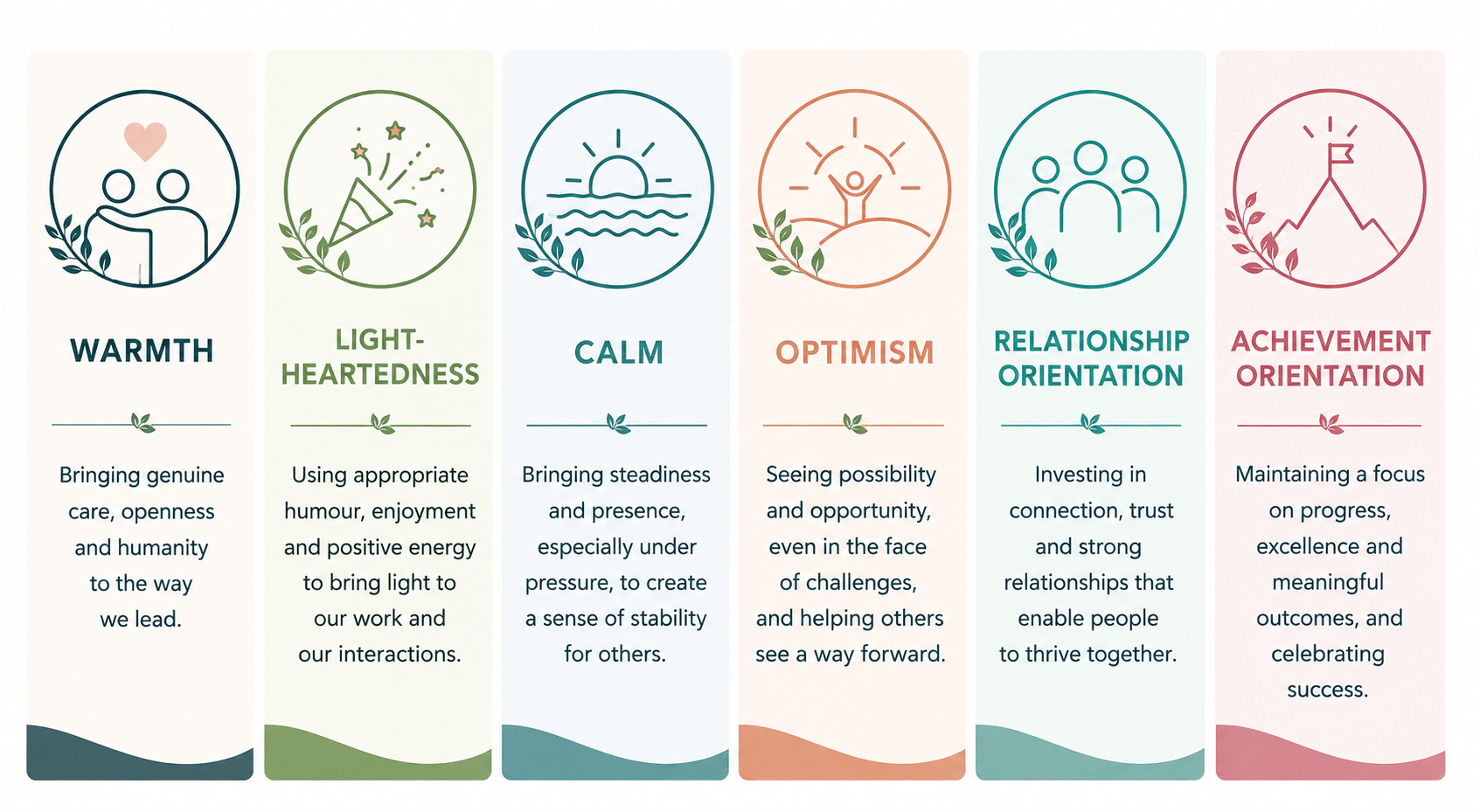
My research into Joyful Leadership identified six characteristics that help us understand what this leadership style looks like in practice: warmth, light-heartedness, calm, optimism, relationship orientation and achievement orientation.¹
Together, they provide a very different way of thinking about joy at work.
Warmth
Warmth is about bringing genuine care, openness and humanity to the way we lead.
It can be as simple as noticing when someone isn't quite themselves, taking the time to ask how they are, listening properly to the answer, or making sure people know that their contribution matters.
Warmth does not mean avoiding expectations or difficult conversations. In fact, some of the strongest leadership relationships allow us to have difficult conversations precisely because trust and care already exist.
People need to know that there is a human being behind the leadership role.
Light-heartedness
Work can be serious without being serious all of the time.
Light-heartedness is the appropriate use of humour, enjoyment and positive energy in our interactions with others.
It might be laughing together during a busy week, celebrating a small win, sharing a moment of humour after something goes wrong or simply creating an environment where people feel comfortable enough to enjoy being together.
Those moments can look insignificant.
They aren't.
Joy is an emotion, and research into positive emotions shows that these experiences can broaden the way we think and respond and help build enduring personal and social resources.²
Calm
One of the clearest tests of leadership comes when things don't go according to plan.
Calm does not mean that a leader never experiences stress, frustration or uncertainty. It means being able to bring steadiness to the way we respond.
When an unexpected challenge arises, a calm leader can acknowledge what is happening, communicate clearly and move towards problem-solving rather than simply reacting.
Leaders influence the emotional environment around them. How we show up under pressure matters.
Sometimes the most powerful thing a leader can bring into a difficult situation is simply steadiness.
Optimism
Optimism is not pretending everything will be fine.
It is the ability to see possibility even when circumstances are difficult.
An optimistic leader can acknowledge the reality of a challenge while still helping people see that there is a way forward.
During periods of change, that might mean recognising uncertainty while drawing attention to opportunities for learning, growth or innovation.
Optimism gives people somewhere to look beyond the immediate problem.
It says: this is difficult, and we can still move forward.
Relationship Orientation
Leadership happens through relationships.
Relationship-oriented leaders deliberately invest in connection. They have conversations. They listen. They build trust. They know their people and create opportunities for people to know one another.
This is not an optional extra to the "real work" of leadership.
Relationships are part of the real work.
The quality of relationships within an organisation influences how people communicate, collaborate, respond to challenges and experience their work.
When people feel connected, they are better positioned to contribute.
Achievement Orientation
This characteristic sometimes surprises people.
Why would achievement be part of Joyful Leadership?
Because joy and performance are not opposites.
Joyful Leadership does not mean lowering standards. Achievement orientation means maintaining a focus on progress, accomplishment and meaningful outcomes.
Leaders set clear goals, provide feedback, recognise progress and celebrate success.
And celebration matters.
Too often, organisations move immediately from one target to the next without stopping to acknowledge what people have achieved.
Joyful leaders create space to notice progress while continuing to move forward.
Bringing the Six Together
No single characteristic creates Joyful Leadership.
It is the combination that matters.
Warmth brings humanity.
Light-heartedness creates moments of positive energy and enjoyment.
Calm brings steadiness.
Optimism creates possibility.
Relationship orientation builds connection.
Achievement orientation keeps people moving towards meaningful outcomes.
Together, these characteristics challenge the idea that leaders need to choose between people and performance.
My research into Joyful Leadership suggests a different possibility.¹ ³
We can lead organisations where people are supported and accountable.
Where relationships matter and results matter.
Where challenges are acknowledged and there is still room for optimism, humour and joy.
Joyful Leadership isn't about making everybody happy.
It is about how we lead.
And those everyday choices help shape the experience of work for the people around us.
Joyful Leadership characteristics © Katie McIntyre, 2026. All rights reserved.
References
1. McIntyre, K. (2025). What is Joyful Leadership? [Doctoral dissertation, University of the Sunshine Coast].
2. Fredrickson, B. L. (2001). The role of positive emotions in positive psychology: The broaden-and-build theory of positive emotions. American Psychologist, 56(3), 218–226.
3. McIntyre, K., Graham, W., Mulcahy, R., & Lawley, M. (2024). A conceptualization of a joyful leadership style. In N. M. Ashkanasy, A. C. Troth, & R. H. Humphrey (Eds.), Emotion in organizations: A coat of many colors (Research on Emotion in Organizations, Vol. 19, pp. 219–243). Emerald Publishing Limited.
Dr Katie McIntyre Founder,
Joyful Leadership Academy