July 2026
Executive Excellence Is a Process, Not a Destination
Model Created by Dr Katie McIntyre and Professor Deanna Grant-Smith
Great strategies do not always lead to great outcomes.
Organisations can have a compelling vision, talented people and carefully developed strategic priorities, yet still struggle to translate intent into meaningful action. The challenge is often not the strategy itself. It is what happens next.
Execution requires more than a plan. It requires clarity about what matters, the ability to act and adapt, opportunities to learn from what happens, and a culture that enables people to continue performing over time.
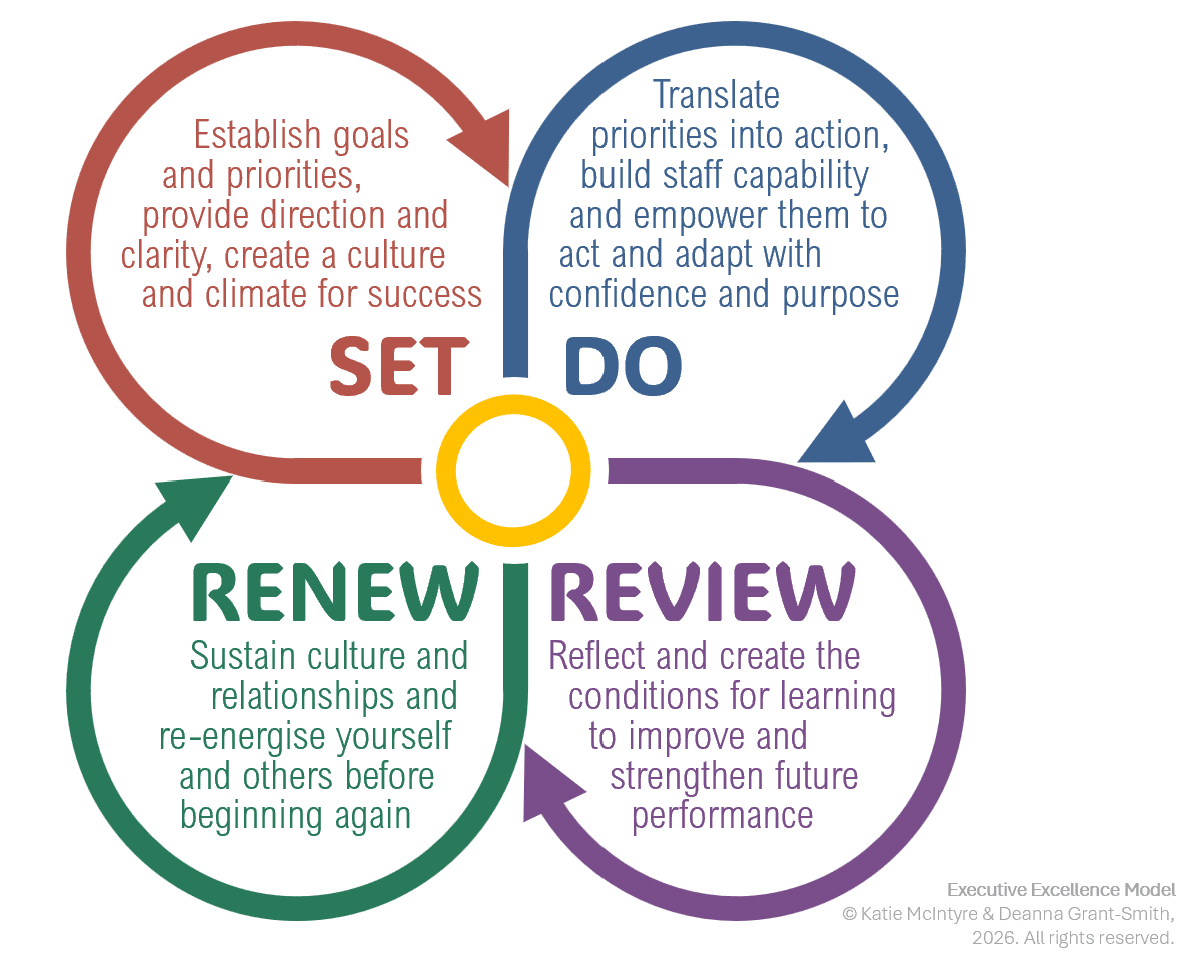
This is the thinking behind the Set–Do–Review–Renew Executive Excellence Process (McIntyre & Grant-Smith, 2026).
SET: Create the Conditions for Success
Execution begins before action is taken.
SET is about establishing the foundations that enable people and teams to succeed. It asks leaders to consider five areas:
Set the Direction — Where are we going?
Set the Priorities — What matters most?
Set the Culture — How do we work together?
Set the Climate — What does it feel like to work here?
Set the Conditions — What needs to be in place for us to succeed?
Research into team effectiveness reinforces the importance of deliberately creating the conditions that support effective performance. Hackman and Wageman¹ emphasised that leadership is not simply about intervening when problems arise. Leaders can have significant impact by establishing the conditions that enable teams to use their collective capabilities effectively.
Before asking, “How do we get people to execute?”, there may be a more useful question:
Have we created the conditions that make successful execution possible?
DO: Turn Direction Into Action
Once direction has been established, attention shifts to execution.
DO is where strategic priorities become everyday decisions, behaviours and action:
Do Communicate — Keep people connected to what matters.
Do Decide — Make decisions and enable decisions to happen.
Do Enable — Remove barriers and empower people to act.
Do Adapt — Respond to what is happening and adjust as needed.
Do Connect — Maintain relationships and the human experience while delivering.
Execution rarely happens exactly as planned. Weick's² work on sensemaking helps us understand how people interpret changing and ambiguous circumstances sufficiently to determine what to do next.
For leaders, effective execution therefore requires both focus and adaptability.
The question becomes:
How do we maintain direction while making sense of what is happening around us?
REVIEW: Learn From What Happened
Review is more than asking:
Did we hit the target?
A more powerful question is:
What is the evidence telling us, and what do we learn from it?
REVIEW considers five areas:
Review Outcomes — What did we achieve?
Review Evidence — What are the data, feedback and other signals telling us?
Review Process — How did we get there? What helped or hindered?
Review Experience — How did people experience the work?
Review Learning — What do we now know that we didn't know before?
Argyris and Schön's³ distinction between single-loop and double-loop learning is particularly useful here. Single-loop learning involves identifying a gap between expected and actual results and making adjustments to improve performance. Double-loop learning goes deeper by questioning the assumptions, beliefs and practices that shaped those actions.
Instead of only asking:
How can we do this better next time?
Double-loop learning encourages us to go further:
Why are we doing it this way in the first place? What assumptions are we making? Do those assumptions still hold?
That is where review becomes genuine organisational learning.
RENEW: Create the Culture That Sustains Excellence
Execution cannot be sustained through targets, systems and accountability alone.
People matter.
Relationships matter.
Culture matters.
RENEW focuses on strengthening the cultural and human conditions that enable people to continue setting, doing and reviewing effectively.
Joyful Leadership provides an evidence-based way of thinking about these conditions. Research identifies six characteristics of Joyful Leadership: warmth, light-heartedness, calm, optimism, relationship orientation and achievement orientation.⁴
These characteristics bring together two things that are sometimes incorrectly treated as opposites: people and performance.
Renewal is not about lowering expectations or stepping away from accountability. It is about deliberately creating cultures in which people can remain connected, capable and energised while pursuing meaningful outcomes.
The question becomes:
Are we creating a culture that enables people and performance to thrive?
And Then We Begin Again
SET creates clarity and the conditions for action.
DO translates that clarity into execution.
REVIEW creates learning from what happens.
RENEW strengthens the culture and capability that sustain the work.
And then we SET again.
Because executive excellence is not something an organisation achieves once and then possesses.
It is an ongoing practice of clarity, action, learning and renewal.
Set. Do. Review. Renew.
Set–Do–Review–Renew Executive Excellence Process © McIntyre & Grant-Smith, 2026. All rights reserved.
References
1. Hackman, J. R., & Wageman, R. (2005). A theory of team coaching. Academy of Management Review, 30(2), 269–287. View publication
2. Weick, K. E. (1995). Sensemaking in organizations. SAGE Publications. View publication
3. Argyris, C., & Schön, D. A. (1978). Organizational learning: A theory of action perspective. Addison-Wesley. View publication
4. McIntyre, K. (2025). What is Joyful Leadership? [Doctoral dissertation, University of the Sunshine Coast]. View thesis
Dr Katie McIntyre
Founder and CEO
Joyful Leadership Academy